Registration is closed
Are you interested in this course?
Please fill in the form below, and we will let you know as soon as the next edition is announced.
You can also use this form to request this as an in-house course for your group.


Live Online Course – 2nd Edition
June 8th-12th, 2026
Contact: courses@transmittingscience.com

Are you interested in this course?
Please fill in the form below, and we will let you know as soon as the next edition is announced.
You can also use this form to request this as an in-house course for your group.
Click here to express interest in this course
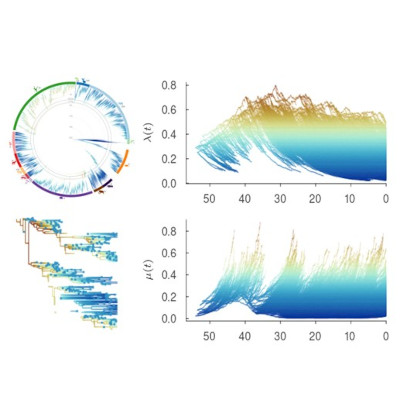
This course provides a primer on Macroecology, focusing on geographic patterns of biodiversity and how those patterns are affected by species evolution and adaptation over time. It combines historical components of geographic patterns, phylogenies, and ecology to provide a comprehensive overview of evolutionary macroecology.
The course has a strong practical component in R. Students will learn to manipulate large geographic databases in R, grid-map biodiversity in various forms, conduct analyses of biogeographic regionalization incorporating evolutionary history, and estimate phylogenetic turnover and historical dispersal in geographic space. The practical sessions also cover common metrics in community phylogenetics and diversification, focusing on large geographic scales.
At the end of this course, participants will be able to:
Several datasets will be provided to illustrate the application of these methods. Participants are encouraged to bring their own datasets to analyze and discuss with the instructor.
Places are limited to 16 participants.
Introduction to Macroecology & Mapping Biodiversity
Theory
Practice
Phylogenies in Macroecology I
Theory
Practice:
Phylogenies in Macroecology II
Theory
Practice:
Biogeographic Regionalization & Evolutionary History
Theory
Practice
Integrated Analyses & Herodotools
Theory
Practice
A basic to intermediate level of R knowledge is required. Students must be able to load and save data, understand the functionality of packages, manipulate vectors and data frames, and use basic functions.
All participants must have a personal computer with current versions of R and R Studio.
Online live sessions from June 8th-12th, 2026.
From 13:00-17:30 (Madrid time zone).
Total course hours: 32.5 (22.5 hours of online live lessons, plus 10 hours of participants working on their own between the live sessions).
This course is equivalent to 1 ECTS (European Credit Transfer System). The recognition of ECTS by other institutions depends on each university or school.
In the live sessions, we will combine online lectures with hands-on computational exercises in R, to provide both theoretical understanding and practical skills.
Live sessions will be recorded. However, attendance to the live sessions is required to obtain the course certificate.
This course will be delivered in English.




 Copyright Oscar Sanisidro





 Carmona et al. Science Advances, 2021 Vol 7, Issue 13