
Live Online Course – 8th Edition
Mapping Trait Evolution
May 26th, 28th, and 30th & June 2nd and 4th, 2025
Contact


Live Online Course – 8th Edition
May 26th, 28th, and 30th & June 2nd and 4th, 2025
Are you interested in this course?
Please fill in the form below, and we will let you know as soon as the next edition is announced.
You can also use this form to request this as an in-house course for your group.
Click here to express interest in this course
The course provides a comprehensive overview of the state-of-the-art methods in mapping phenotypic trait evolution and will provide participants with a springboard to using these methods to answering their own research questions.
We focus on analyses that use a phylogenetic tree and observed trait information from tip taxa (extant and/or extinct) to describe how traits have changed along the branches of a phylogeny. The course covers methods that estimate and test patterns related to changes in mean, covariation, and rate. Applications for continuous and categorical, and univariate and multivariate research designs are discussed.
At the end of this course, participants will have developed an understanding of:
(1) Brownian motion and Ornstein-Uhlenbeck models of evolution.
(2) How these models can be applied to estimate and test patterns of trait evolution.
(3) What the advantages and disadvantages are of different models/methods.
(4) How to recognize which model/method is most appropriate given a particular dataset and research question.
We provide several data sets that will be used to exemplify the application of these methods. We do, however, encourage participants to work with their own data so as to get direct experience with analysing precisely what they expect to analyse.
Methods from the following R packages will be discussed: ape, geiger, phytools, evomap, l1ou, bayou, surface, OUwie, mvMORPH, geomorph (this list may change as new packages become available).
Important note: Please bear in mind that this course is not about reconstructing (building) phylogenetic trees; the methods we cover in this course assume that the phylogeny is known.
Places are limited to 16 participants.
Graduate or postgraduate degree in any Biosciences discipline. Knowledge of multivariate statistics.
A reminder of R-skills that are of particular relevance when applying phylogenetic comparative methods will be given on the first day, however a medium level of R knowledge is required for following the course (i.e. knowledge on how to load and save data, manipulate data frames, use basic plotting functions, and use functions to analyse data).
Participants must have a personal computer (Windows, Mac, Linux) with a recent R and R studio version installed.
R packages that will be used during the course: ape, Geiger, bayou, phylolm, surface, OUwie, mvMORPH, nlme, caper, evomap, phytools, motmot, geiger, ape, evomap, BayesTraits.
Online live sessions on May 26th, 28th, and 30th & June 2nd and 4th, 2025.
14:00-18:00 (Madrid time zone)
Total course hours: 35 (20 hours of online live lessons, plus 15 hours of participants working on their own).
This course is equivalent to 1 ECTS (European Credit Transfer System) at the Life Science Zurich Graduate School.
The recognition of ECTS by other institutions depends on each university or school.
In the live sessions we will combine online lectures with hands-on computational exercises, in R.
Live sessions will be recorded. However, attendance to the live sessions is required to obtain the course certificate.
This course will be delivered in English.

Dr. Jeroen B. Smaers
Stony Brook University
United States of America


 Bouckaert et al. PLoS Comput Biol 15(4): e1006650
 Copyright Oscar Sanisidro
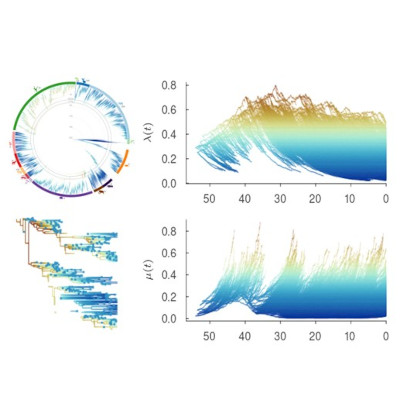

 Carmona et al. Science Advances, 2021 Vol 7, Issue 13

