Registration is closed
Are you interested in this course?
Please fill in the form below, and we will let you know as soon as the next edition is announced.
You can also use this form to request this as an in-house course for your group.


Live Online Course – 8th Edition
March 2nd-20th, 2026
Contact: courses@transmittingscience.com

Are you interested in this course?
Please fill in the form below, and we will let you know as soon as the next edition is announced.
You can also use this form to request this as an in-house course for your group.
Click here to express interest in this course
An accurate reconstruction of evolutionary relationships among species is the cornerstone of evolutionary biology. Building phylogenetic trees thus provides the fundamental framework upon which systematic, biogeographic and evolutionary research operates.
Morphological phylogenetics provides a unique toolkit for inferring relationships, considering that the vast majority of the species that have ever lived are now extinct and can only be assessed based on morphological data. Additionally, combining fossils and morphological data with molecular data from extant species is becoming the most comprehensive method of assessing phylogenetic relationships on deep time and the time of origin of major evolutionary lineages.
In this course, we will focus on the analysis of morphological data (and combining morphological data with molecular data) using multiple optimality criteria for phylogenetic inference. We will discuss the best available approaches to construct morphological data sets and their impact on phylogenies. We will follow with theory and hands-on practice of phylogenetic programs using maximum parsimony, maximum likelihood and Bayesian inference. Participants will learn how to combine morphological and molecular data for total evidence analyses, how to conduct time-calibrations using tip and node dating, different birth-death models, morphological clocks and combined evidence relaxed clock analyses. Customized course materials will be provided.
Places are limited to 18 participants.
Graduate or postgraduate degree in Life Sciences.
Prior knowledge of concepts in systematics and phylogenetics is strongly recommended.
During the course, participants will work with the following software, which will be provided: Mesquite, TNT, RAxML, IQTree, Mr. Bayes and BEAST.
Online live sessions on March 2nd, 4th, 6th, 9th, 11th, 13th, 16th, 18th, and 20th, 2026.
From 16:00 to 19:30 (Madrid time zone).
Total course hours: 37 (31.5 hours of online live lessons, plus 5.5 hours of prerecorded classes and assignments.
This course is equivalent to 2 ECTS (European Credit Transfer System). The recognition of ECTS by other institutions depends on each university or school.
In the live sessions we will combine online lectures with hands-on computational exercises.
Live sessions will be recorded. However, attendance to the live sessions is required to obtain the course certificate.
This course will be delivered in English.

Dr. Nicolas Mongiardino Koch
Colorado State University
United States of America


 Bouckaert et al. PLoS Comput Biol 15(4): e1006650
 Copyright Oscar Sanisidro
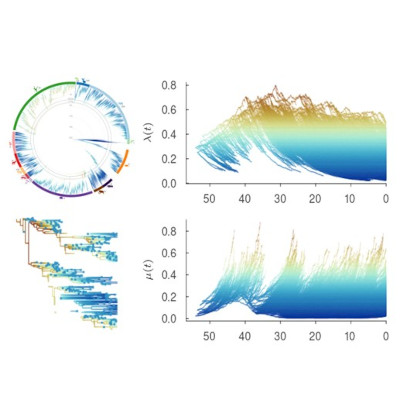


 Carmona et al. Science Advances, 2021 Vol 7, Issue 13
